
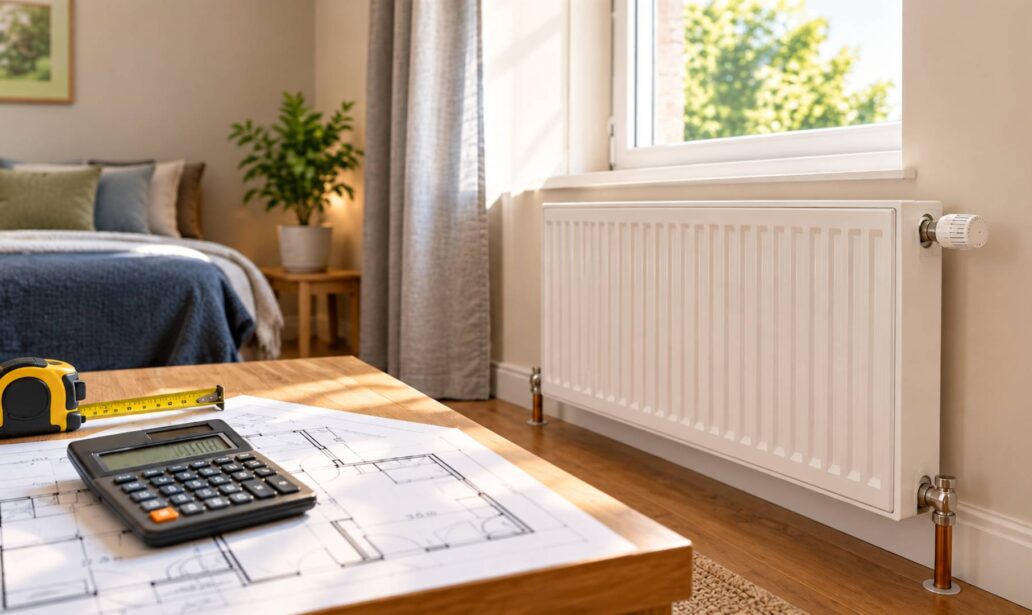
Choosing a radiator is not simply a matter of picking a size that fits the wall. Each room loses heat at a different rate, so the amount of warmth it needs depends on more than floor area alone. Getting the heat output right helps the room warm properly and reduces the risk of fitting a radiator that is too weak for the space.
When looking at options such as Stelrad Radiators, the useful starting point is the room’s required heat output rather than the radiator’s appearance or dimensions. A proper calculation considers room size, insulation, windows, external walls and the temperature at which the heating system operates.
Why Room Size Alone Is Not Enough
Length, width and ceiling height matter because they show how much space needs heating. However, two rooms with identical dimensions can have very different heating needs.
A well-insulated internal room may retain warmth for longer, while a room with several outside walls, older glazing or an uninsulated roof above it may lose heat faster. This is why simple rules based only on square metres can be misleading.
The aim is to replace the heat the room loses in colder conditions. This is known as a heat-loss calculation. The final figure can be expressed in watts or BTU per hour, both of which are commonly used when assessing radiator output.
Start With a Room-by-Room Heat-Loss Calculation
Heating requirements should be worked out for each room separately. Dividing one whole-house figure between rooms does not reflect differences in exposure, glazing, insulation or how individual rooms are used.
A heat-loss calculator can provide an estimate using information about the room and the building. More detailed calculations may also consider heat lost through walls, floors, ceilings and windows, as well as ventilation.
For a straightforward radiator replacement, a reliable heat-loss calculator can provide a useful starting point. For a major renovation, new heating system or property with unusual construction, a more detailed assessment is often more appropriate.
Factors That Change the Heat Requirement
Several details can increase or reduce the amount of heat a room needs. These should be checked before selecting a radiator:
- Room dimensions: Measure the length, width and ceiling height accurately.
- External walls: Rooms with more walls facing outside will often lose heat more quickly.
- Windows and glazing: Large windows and older glazing can increase heat loss.
- Insulation: Wall, floor and roof insulation can significantly affect how well a room retains warmth.
- What is above and below: A heated room above or below will affect heat loss differently from an unheated garage, loft or exposed area.
- Room use: Bedrooms, living rooms and bathrooms may have different comfort requirements.
- Ventilation and draughts: Air vents, chimneys and gaps around doors or windows can allow heat to escape.
These factors should be considered together rather than in isolation. The more accurate the information used in the calculation, the more useful the resulting heat requirement will be.
Understand BTU and Watts
Radiator outputs are commonly shown in watts and BTU per hour. Both measurements describe heat output, but they use different units.
One watt is approximately equal to 3.412 BTU per hour. This means a figure can be converted if a heat-loss calculation is given in one unit and the radiator specification is shown in the other.
The main point is to compare like with like. If your room calculation is shown in watts, compare it against the radiator’s watt output. If you are working in BTU, use the BTU figure instead.
Check the Heating System Temperature
A radiator does not produce the same amount of heat at every water temperature. Its performance depends partly on the difference between the average radiator temperature and the desired room temperature. This is commonly referred to as Delta T.
Radiator outputs are often quoted at Delta T50 as a standard comparison point. However, some heating systems operate at lower temperatures. In those situations, the same radiator may provide less heat than the output shown at Delta T50.
This is especially important when moving from a conventional boiler system to lower-temperature heating. A radiator that worked well under one system may not provide the same level of output when the water temperature is reduced.
For that reason, always check that the stated radiator output reflects the operating conditions of the heating system being used.
Match the Required Output to the Radiator
Once the heat requirement has been calculated, the next step is to find a radiator that can provide enough output for the room.
Wall space still matters, but it should not be the first consideration. A radiator with additional panels or convector fins may provide more heat than a larger-looking model with a simpler construction.
This means physical dimensions alone do not tell you how much warmth a radiator can deliver. Always check the heat output rather than assuming that a taller or wider radiator will automatically perform better.
If wall space is limited, compare different radiator styles and configurations that can meet the required output without compromising the room layout.
Common Sizing Mistakes to Avoid
One common mistake is replacing an existing radiator with another of exactly the same size without checking the heat requirement again. The property may have changed since the original radiator was fitted.
Improved insulation or upgraded windows may reduce heat loss. On the other hand, changing to a lower-temperature heating system may mean a larger or higher-output radiator is needed.
Another issue is comparing radiator outputs that have been measured at different Delta T values. Figures based on different temperature conditions should not be treated as direct comparisons.
Guessing can also cause problems in rooms with high ceilings, large windows, several external walls or unusual construction. These spaces may need a more careful heat-loss assessment.
When Professional Advice Is Worthwhile
Professional advice can be useful when radiator sizing is part of a wider heating project. This may include replacing a boiler, fitting a heat pump, changing pipework, renovating an older property or upgrading several radiators at once.
A qualified heating engineer or system designer can assess room heat loss alongside system temperatures, available wall space, controls and the overall heating setup.
This can be particularly valuable where the building has unusual features or where lower water temperatures are planned. Correct sizing at the design stage can help avoid problems with rooms that struggle to reach a comfortable temperature.
Conclusion
Working out the heat output a room genuinely needs starts with understanding how much heat the space loses. Accurate room measurements, insulation levels, glazing, external walls, ventilation and surrounding spaces all influence the final figure.
Once the required output is known, compare it with radiator performance at the correct operating temperature for your heating system. A reliable heat-loss calculation is a sensible starting point, while professional advice can be valuable for complex properties, major heating changes or lower-temperature systems.